How Child Support Is Calculated, Explained for Dads
Updated October 14, 2026
Key takeaways
- Child support is a formula, not a judge’s opinion. Almost every state publishes the formula and a calculator.
- Most states use the income shares model, which adds both parents’ incomes together. A few base it on the paying parent’s income alone.
- Overnights matter. In most states, more parenting time changes the number, though rarely as much as dads expect.
- Health insurance for the kids and work-related childcare usually get added on top of the base figure.
- If your income drops, file for a modification immediately. Most states will not backdate relief to before the day you filed.
Most dads walk into this expecting a judge to size them up and pick a number. That is not how it works. Child support is a formula written into state law, and in almost every state you can run it yourself before you ever see a courtroom.
Knowing the formula does two things. It stops the number being a shock, and it tells you which parts of it you can legitimately affect.
The three formulas states use
According to the National Conference of State Legislatures, every state uses one of three models:
| Model | How it works | Where |
|---|---|---|
| Income shares | Adds both parents’ incomes, estimates what the household would have spent on the kids, then splits that by each parent’s share of the income | 41 states, the most common by far |
| Percentage of income | Applies a set percentage of the paying parent’s income, ignoring the other parent’s | Alaska, Mississippi, Nevada, North Dakota, Texas, Wisconsin |
| Melson formula | An income shares variation that protects each parent’s basic needs first, then adds a share of leftover income for the kids | Delaware, Hawaii, Montana |
The District of Columbia uses a hybrid. Whichever applies to you, the guideline number is presumed correct, and a judge needs a stated reason to depart from it.
What goes into the calculation
Income, and more of it than you think
- Wages, salary, tips, commissions, and usually overtime and bonuses if they are regular.
- Self-employment income, calculated after legitimate business expenses but not after the creative ones.
- Often unemployment, disability, pensions, rental income, and sometimes recurring gifts.
- Imputed income. If a court decides you quit or downshifted to lower your obligation, it can calculate support on what you could earn instead of what you do earn. Quitting a job to reduce support is the single most expensive mistake in this area.
The kids’ add-ons
- The health insurance premium for the children, which is why who carries their coverage matters to the bottom line.
- Work-related childcare and after-school care.
- Extraordinary medical or dental costs, and sometimes special education or travel for visitation.
Parenting time
In most states the number of overnights you have feeds directly into the formula, and crossing a threshold changes the result. The effect is real but usually smaller than dads expect, because two households still cost what they cost.
Two honest warnings. First, asking for overnights you will not actually use is obvious to everyone in the room, and it damages you on the custody side. Second, in a true 50/50 arrangement the higher earner still typically pays something, because the formula is balancing the kids’ standard of living across both homes. If you are working out a schedule, the 50/50 schedules that actually work covers the practical side.
How to get your real number today
- Search for your state name plus “child support guidelines calculator” and use the official state version, usually on a state courts or child support services site. Skip the ad-heavy copies.
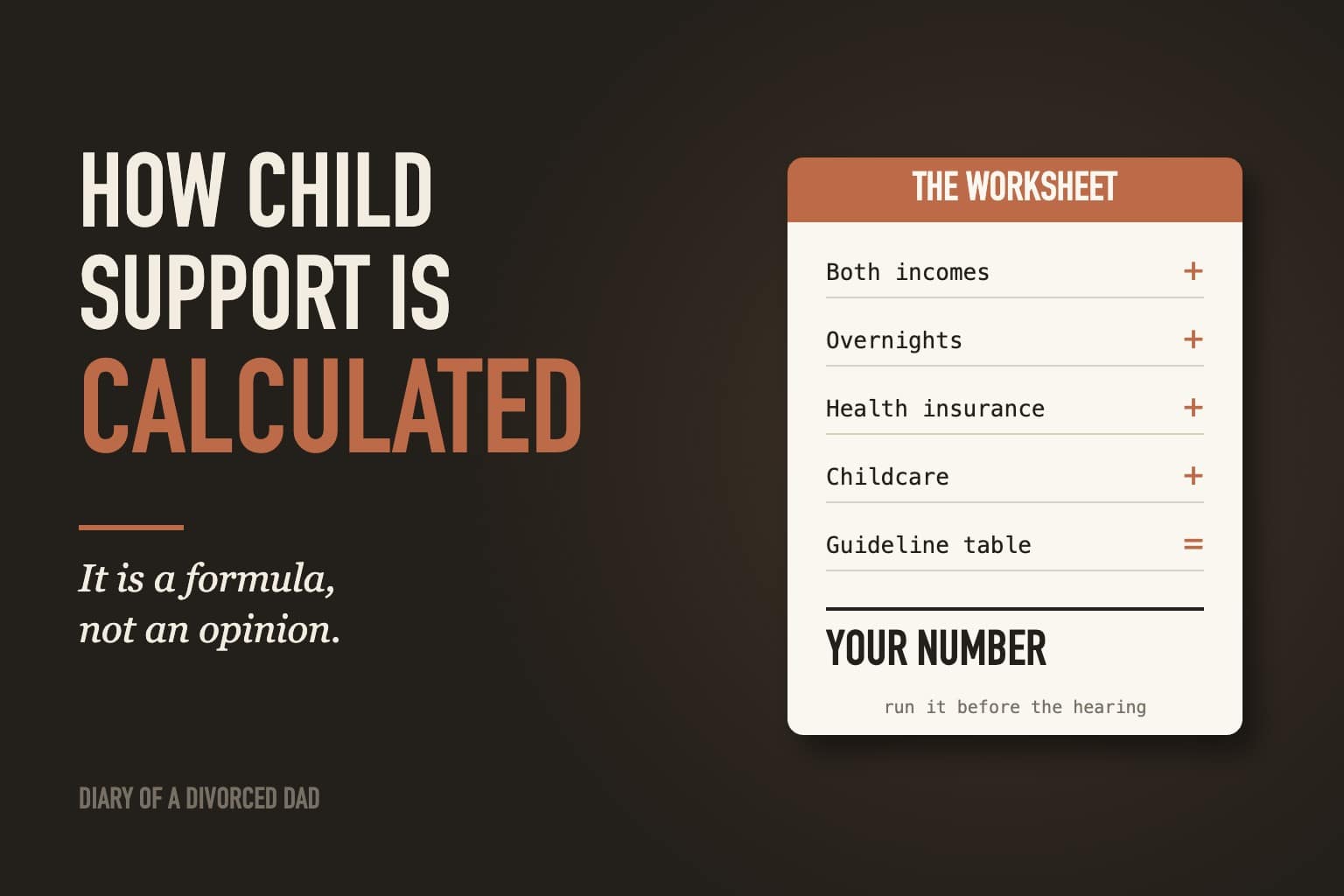
- Gather pay stubs for both of you if you have them, the cost of the kids’ health insurance, childcare costs, and the number of overnights each parent has.
- Run it twice: once on the schedule you expect, once on the schedule she is asking for. Now you know what the difference is actually worth.
- If you cannot find your state’s calculator, the federal Office of Child Support Enforcement links out to every state program.
Bring that printout to your lawyer. It turns an hour of billable explaining into ten minutes of checking, which is real money. See what a divorce actually costs for why that matters.
What child support is not
- Not tax deductible. You do not deduct it, and she does not report it as income. Alimony is a separate question with its own rules.
- Not tied to visitation. She cannot withhold the kids because you are behind, and you cannot withhold money because she is late for exchanges. Courts treat these as two separate matters, and mixing them costs you credibility.
- Not automatically over at 18. Many states run support to high school graduation or 19, and some extend it for a disabled child. Check your order and your state.
- Not reduced by what you buy directly. Clothes, shoes, and a bigger apartment are not credits against your obligation. Pay the order, then be generous if you can.
When the number should change
Support is not carved in stone, but changing it takes a filing. Most states require a substantial change in circumstances, and some set a specific trigger, such as the new calculation differing from the old one by a set percentage.
- A real change in either parent’s income, up or down.
- A lasting change in the parenting schedule.
- A change in childcare or health insurance costs.
- Another child, in some states.
File the day the change happens. Courts generally cannot reduce what accrued before you filed, so a layoff in January and a filing in June usually means five months of arrears at the old rate, and arrears rarely go away. If money is the problem right now, running two homes on one paycheck has the order of operations.
Keep a record that survives a hearing
- Pay through the state disbursement unit or whatever channel the order names, so every payment is logged.
- If you ever pay directly, get it in writing that it was support. Cash with no paper trail is a gift in the eyes of a court.
- Keep receipts for insurance premiums, childcare, and medical costs you cover.
- Save the calculation you ran and the pay stubs behind it.
That folder is also what makes a modification quick instead of expensive. More on building that habit in how to prepare for a custody battle as a dad.
The part that actually helps
Nobody enjoys this number. But the dads who fare best treat support as a bill rather than a verdict, pay it first every month, and spend their energy on the parts they control: their time, their record, and their kids. Build the payment into the budget, then stop relitigating it in your head. Here is how to build that budget, and for the wider picture, start with how to get through a divorce as a man.
If you want a simple place to start, our free 7-Day Divorced Dad Reset gives you one small, doable step a day.
About Diary of a Divorced Dad
Diary of a Divorced Dad is a community of fathers rebuilding their lives after divorce. Our articles are written and reviewed by dads who have actually been through it. See how we work.
This is lived experience and general information, not legal or financial advice. Child support formulas, thresholds, and modification rules vary by state and by case, so run your own state’s guidelines and talk to a family law attorney about your situation.
If the number the formula produces is one you genuinely cannot pay, read what to do when you cannot afford child support, and file the modification before the arrears build.
If you are self employed, the formula works differently and the fight is about what counts as income. We cover that here. If you serve, military pay and allowances have their own rules.
Come tax season, the question changes from what you pay to who claims the children. That is decided by nights and Form 8332, not by your decree.
Frequently asked questions
How is child support calculated?
Every state uses a published formula. Forty-one states use the income shares model, which combines both parents’ incomes and divides the children’s estimated costs proportionally. Six states apply a percentage of the paying parent’s income only, and three use the Melson formula. Health insurance for the children, childcare, and the number of overnights usually adjust the result.
Does 50/50 custody mean no child support?
Usually not. Even with equal overnights, the parent who earns more typically pays something, because the formula aims to keep the children’s standard of living similar in both homes. Equal time reduces the amount in most states rather than eliminating it.
Is child support tax deductible?
No. The paying parent cannot deduct child support, and the receiving parent does not report it as income. Alimony is treated differently and depends on when your order was entered.
What happens if I lose my job?
File for a modification immediately. Courts generally will not reduce support that accrued before the date you filed, so waiting creates arrears that usually cannot be erased. Keep paying what you can in the meantime, through the official channel.
Can my ex stop me seeing the kids if I am behind on support?
No. Courts treat support and parenting time as separate obligations. Being behind does not forfeit your time, and being denied time does not excuse the payments. Document both and take them to the court rather than handling it yourself.