Two Homes, One Paycheck: How Divorced Dads Make It Work
Updated October 14, 2026
Key takeaways
- Two households cost more than one, and the shortfall is usually in the fixed bills, not the groceries.
- Rebuild the budget from your new take-home pay, not the old household number.
- Housing is the biggest lever you have. Everything else is rounding.
- If your income drops, ask the court to change support right away. Falling behind quietly is the expensive mistake.
- Getting help for a while is not failing your kids. Hiding the trouble until it becomes debt is.
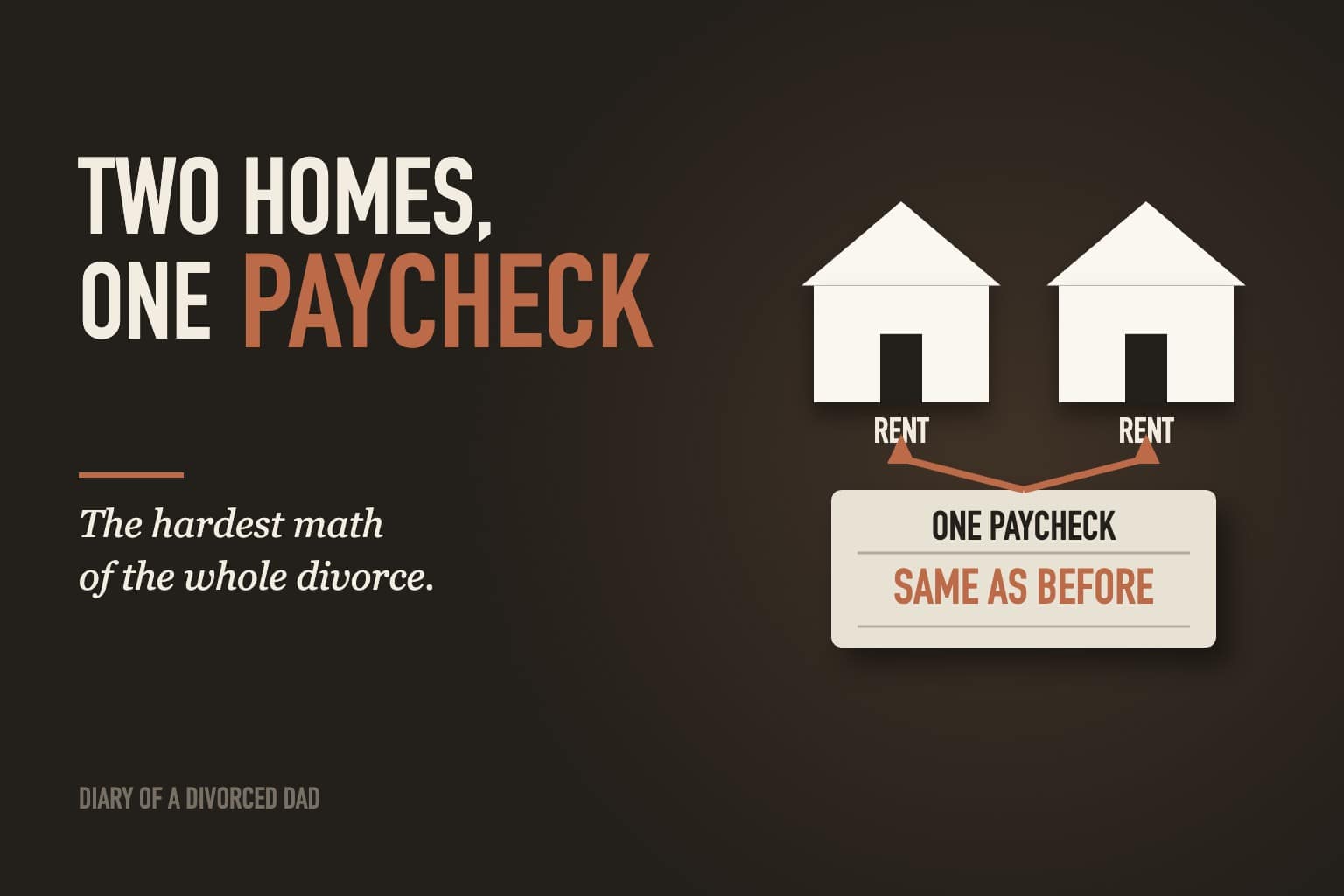
The math of divorce is simple and brutal. The same income that covered one house now covers two, and nobody gets a raise for it. Rent, power, internet, and insurance all get paid twice, while your paycheck stays exactly the same.
Most dads feel that squeeze around month two, when the adrenaline wears off and the second set of bills lands. Here is how to get the numbers to work, in the order that actually helps.
Start with the real number, not the old one
Write down what actually hits your account each month now, after taxes, after any support, after insurance changes. That is your real income, and it is usually lower than the number in your head. Then list what leaves:
- Housing: rent or mortgage, utilities, internet, insurance.
- Transportation: car payment, insurance, gas, repairs.
- Support and legal: child support, remaining legal bills.
- Kids: food, clothes, activities, school costs, anything you split with your ex.
- You: food, phone, health insurance, medications, subscriptions.
- Debt: cards and loans, with the minimums and the interest rates.
Our budget after divorce guide walks through this with a template. Do it on paper or in a spreadsheet, not in your head. The number in your head is always wrong, and usually optimistic.
Housing is the only lever big enough to matter
You can give up coffee and streaming and still be short. The fix is almost always housing. If your rent or mortgage is eating more than about a third of your take-home pay, nothing downstream will save you.
- Ask what you actually need. A two bedroom you can afford beats a three bedroom you cannot. Kids sharing a room is normal.
- Trade space for distance, carefully. Cheaper further out can cost you gas, drive time, and exchanges. Sometimes it is still the right call. Price it honestly.
- Consider a roommate for a season. Awkward, and it works, especially on your weeks without the kids.
- Decide about the house on purpose. Keeping the family home to spare the kids one more change is a real motive. It has sunk more than one divorced dad. Run the numbers on the refinance and taxes before you commit.
If you have not moved yet, should you move out during a divorce covers what leaving does to the house, the kids, and the money. Once you have a place, here is how to set it up without going into debt.
Cut the fixed bills before the small ones
An hour on the phone is worth more than a month of skipping lunch out.
- Car insurance. Shop it. Your rate changed when your address and household did anyway.
- Phone plan. If you were on a family plan with your ex, sort that out now rather than arguing about it for a year.
- Subscriptions. Check what is still charging you for a household that no longer exists. Look at the whole card statement, not memory.
- Internet and cable. Call and ask for the new customer rate. It works more often than it should.
- Insurance and benefits at work. A divorce is a qualifying life event, so you can change plans outside open enrollment. Update your beneficiaries while you are in there.
Child support: pay it, track it, and fix it early if you must
Support is not a bill you can quietly fall behind on. Interest and arrears pile up in ways ordinary debt does not, and they follow you.
- Pay through the official channel if your order names one, so every payment is recorded. Cash and handshake arrangements disappear in court.
- Keep records of anything else you cover: insurance, activities, school fees. Screenshots and a folder are enough.
- If your income drops, file for a modification immediately. Most states only change support from the date you ask, not the date you lost the job. Waiting six months creates debt no judge can erase.
- Do not stop paying to punish anyone, and do not accept “just pay me directly instead” without putting it through the court.
Support and parenting time are separate issues in the eyes of most courts. Being behind on one does not excuse withholding the other, in either direction.
When the money still does not add up
There is an order of operations that keeps a rough year from becoming a ruined decade:
- Cover housing, utilities, transportation to work, and food first. Always in that order.
- Pay support and minimums on debts.
- Build a small buffer, even $500, so a tire does not become a credit card balance.
- Then attack the debt with the highest interest.
If you are short even after cutting, ask for help before you reach for a card. Look at utility assistance programs, SNAP, free or reduced school meals, school fee waivers, and local church or community funds. These exist for exactly this, for the stretch where a household splits in two. Using them for a year while you stabilize is not failing your kids. Pretending everything is fine and funding the difference at 26% interest is.
Longer term, rebuilding your finances after divorce covers credit, savings, and retirement, the part that comes after the emergency. And if you are still early in the process, here is what the divorce itself will cost you.
Earning more, realistically
Cutting has a floor. Income does not, but your time with your kids is not up for grabs either. The test for any side work: does it fit in the hours your kids are not with you?
- Overtime or a shift differential at the job you already have, scheduled on your off weeks.
- A raise conversation you have been putting off. Divorce is a decent reason to finally have it.
- Selling what the old house left you with. Tools, furniture, the things nobody uses.
- Skilled side work on your off weekends rather than daily gig driving, which eats your car.
Be careful not to trade all your parenting time for money. The kids remember the time. They will not remember the raise.
What to tell the kids about money
Somewhere between hiding it and dumping it on them is the truth in kid-sized pieces. “We have less right now, so we are doing cheap weekends for a while, and we are fine” is enough. Do not make them the messenger, do not compare houses, and never suggest that the money is why they see less of you.
Cheap weekends are not lesser weekends. Kids remember the park, the pancakes, and the movie on the couch. For more on that, read being a good dad every other weekend, and if you have not had the bigger conversation yet, here is how to talk to your kids about divorce.
The part nobody says out loud
This stretch is temporary, but it does not feel temporary while you are in it. Most dads describe the same arc: a brutal first year, a lighter second one, and a normal that arrives quietly somewhere in the third. The ones who come out clean are the ones who faced the numbers early and asked for help before the hole got deep.
For the bigger picture beyond money, start with how to get through a divorce as a man.
If you want a simple place to start, our free 7-Day Divorced Dad Reset gives you one small, doable step a day.
About Diary of a Divorced Dad
Diary of a Divorced Dad is a community of fathers rebuilding their lives after divorce. Our articles are written and reviewed by dads who have actually been through it. See how we work.
This is lived experience and general information, not legal or financial advice. Support rules and assistance programs vary by state, so talk to a family law attorney or your local child support office about your own case.
Health coverage is usually the biggest new line item in that budget. Here is how insurance works after a divorce, including the 60 day deadline.
Not sure where your support number comes from? Here is how child support is actually calculated, and how to run it yourself.
And if the gap is wide enough that support is going unpaid, do not wait it out. Here is what to do first, because arrears cannot be reduced after the fact.
If your income swings month to month, the support calculation works differently. Here is how courts handle self employed income.
Frequently asked questions
How do divorced dads afford two households?
Usually by resetting housing costs first, cutting fixed bills like insurance and phone plans, keeping support current, and accepting a lower standard of living for a year or two. Housing is the only lever big enough to close a real gap.
What percentage of income should go to rent after divorce?
Aim for about a third of your take-home pay or less on housing. Above that, the rest of the budget rarely works no matter how carefully you cut elsewhere.
What happens if I cannot pay child support?
File for a modification as soon as your income changes. Most states only adjust support from the date you file, so waiting creates arrears that usually cannot be erased. Never simply stop paying.
Should I keep the house after divorce?
Only if you can carry it on one income after refinancing, taxes, and upkeep. Keeping it for the kids is understandable, but a house that eats your whole paycheck costs them more than a move would.
Is it okay to get government help after a divorce?
Yes. Utility assistance, SNAP, and reduced school meals exist for exactly this kind of disruption. Using them while you stabilize is better for your kids than funding the gap with credit cards.