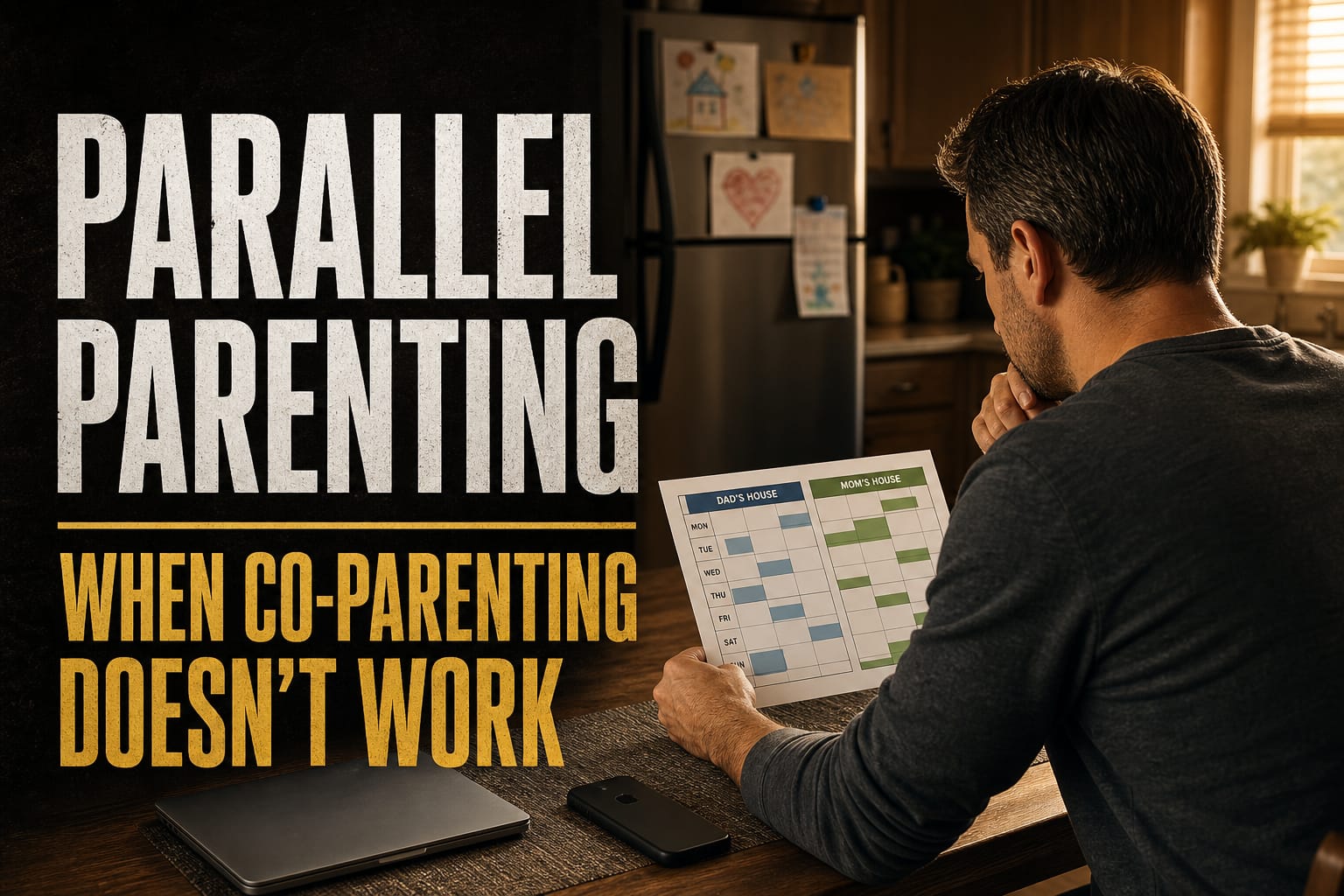
Parallel Parenting: When Co-Parenting With a High-Conflict Ex Doesn’t Work
Updated October 10, 2026
Key takeaways
- Parallel parenting means you stop coordinating with your ex and run two independent households under a detailed court order.
- It is not failure. For high-conflict exes it is often the arrangement that finally lets the kids stop living inside the fight.
- It only works if the order is specific: exact times, exact places, who decides what, and how you communicate.
- Communication moves to writing, usually inside an app, and drops to logistics only.
- Different houses can have different rules. Kids handle that far better than they handle two parents at war.
Co-parenting advice assumes two adults who can have a short, civil phone call. If that is not your situation, most of it is useless, and trying to follow it keeps you in a fight you cannot win.
Every handoff turns into a negotiation. Every text becomes an argument. You have tried being reasonable, being firm, being silent. Your kids have started going quiet in the car on the way back.
Parallel parenting is the arrangement built for exactly that. You both stay fully involved parents. You simply stop being partners about it.
Co-parenting versus parallel parenting
| Co-parenting | Parallel parenting | |
|---|---|---|
| Contact | Calls, texts, flexible swaps | Written only, usually through an app |
| Decisions | Made together | Each parent decides during their own time, with major decisions split or assigned by the order |
| Events | Both attend, sit together | Both may attend, separately, or alternate |
| Schedule | Flexible by agreement | Fixed by the order, exchanged in neutral places |
| Rules | Roughly matched between homes | Each house runs its own way |
| Works when | You can be civil | Civility has repeatedly failed |
What a workable parallel parenting order contains
The whole thing lives or dies on specificity. Anything left to “as the parents agree” becomes the next fight, so your order should nail down:
- Exact times and places. Not “Friday evening” but “Friday 6:00pm at the Walmart on Route 9.” Many families use a public, camera-covered location, or exchange at school so the handoff never happens face to face.
- A full year calendar. Regular schedule, holidays, school breaks, birthdays, summer. See our guide to sorting the holiday schedule before it comes up.
- Decision lanes. Who chooses the doctor, who handles school paperwork, who signs for activities. Divided by area rather than shared, so nothing needs a joint conversation.
- A communication method. Named in the order: one app, written only, with a response window such as 24 or 48 hours for anything non-urgent.
- An emergency definition. What counts as urgent enough to call, and what does not.
- Information sharing. Both parents get school and medical records directly from the school and the doctor, so neither has to ask the other.
How communication works
- Writing only. It removes tone, and it creates a record. Most parallel parenting orders specify an app such as the ones we compare in our rundown of apps for divorced parents.
- Logistics only. Times, health, school, money. Not opinions, not the past.
- One reply, then stop. The gray rock approach pairs naturally with this.
- No messages through the children. Ever. That is the single rule that matters most to how they come out of this.
Two houses, two sets of rules
Dads worry about this more than kids do. Children work out household rules the way they work out teachers: different rooms, different expectations. Bedtime can be 8:30 at your place and 9:30 at hers without damaging anybody.
What does damage them is being asked to carry information between houses, to referee, or to choose. Keep your house consistent, keep your mouth shut about hers, and let the rest go.
What it costs you
It is worth being honest about the trade. You give up flexibility: no casual swaps, no “can you take them an hour early.” You give up being told things informally. You will hear about the school play late, or not at all, which is why direct information access from the school belongs in the order.
What you get back is the end of the daily fight, a record that protects you, and children who stop watching their parents go at it.
How to get there
- Document the pattern. Dates, messages, missed exchanges, in plain factual language.
- Ask your lawyer about a parallel parenting arrangement by name. Many judges are familiar with it in high-conflict cases.
- Bring a draft schedule and decision split rather than a complaint. Courts respond to specifics.
- Expect pushback, and expect the first few months to feel cold. Cold is the point. Cold is quiet.
If you are building toward that, how to prepare for a custody battle as a dad covers the record keeping, and the 50/50 schedules cover what to propose.
One last thing worth saying plainly: parallel parenting is not a lesser arrangement. For a lot of families it is the first thing that works, and the children notice the quiet long before they understand the reason for it.
Been through this? The most useful thing on this site is what other dads have already survived. If you have a story that would help the man reading this at midnight, send it to us here. You can stay anonymous.
If you want a simple place to start, our free 7-Day Divorced Dad Reset gives you one small, doable step a day.
About Diary of a Divorced Dad
Diary of a Divorced Dad is a community of fathers rebuilding their lives after divorce. Our articles are written and reviewed by dads who have actually been through it. See how we work.
This is lived experience and general information, not legal advice. Custody arrangements and what a court will order vary by state and by case, so talk to a family law attorney about yours.
Frequently asked questions
What is parallel parenting?
It is a high-conflict custody arrangement where both parents stay fully involved but stop coordinating with each other. Contact is written and limited to logistics, the schedule is fixed by a detailed order, and each parent makes day to day decisions during their own time.
How is parallel parenting different from co-parenting?
Co-parenting assumes the two of you can communicate and make decisions together. Parallel parenting assumes you cannot, so the order does the coordinating instead: exact times, exact places, assigned decision areas and written-only contact.
Is parallel parenting bad for kids?
No. Research and family courts generally treat ongoing parental conflict as the damaging factor rather than the arrangement itself. Children usually adapt easily to two households with different rules, and benefit from the drop in conflict.
Can parallel parenting become co-parenting later?
Often, yes. Many families use it for a year or two while things cool, then gradually add flexibility. Some stay parallel until the children are grown, and that is a legitimate outcome rather than a failure.
How do I ask a court for parallel parenting?
Document the pattern of conflict with dates and facts, then ask your attorney to propose it by name, with a specific schedule, exchange locations, assigned decision areas and a named communication app. Courts respond far better to a concrete plan than to complaints.