Taxes After Divorce: Who Claims the Kids
Key takeaways
- Your filing status for the whole year is decided by whether you were married on December 31. Nothing else about the year matters.
- The parent the children lived with more nights claims them by default. A divorce decree does not override that. The IRS wants Form 8332.
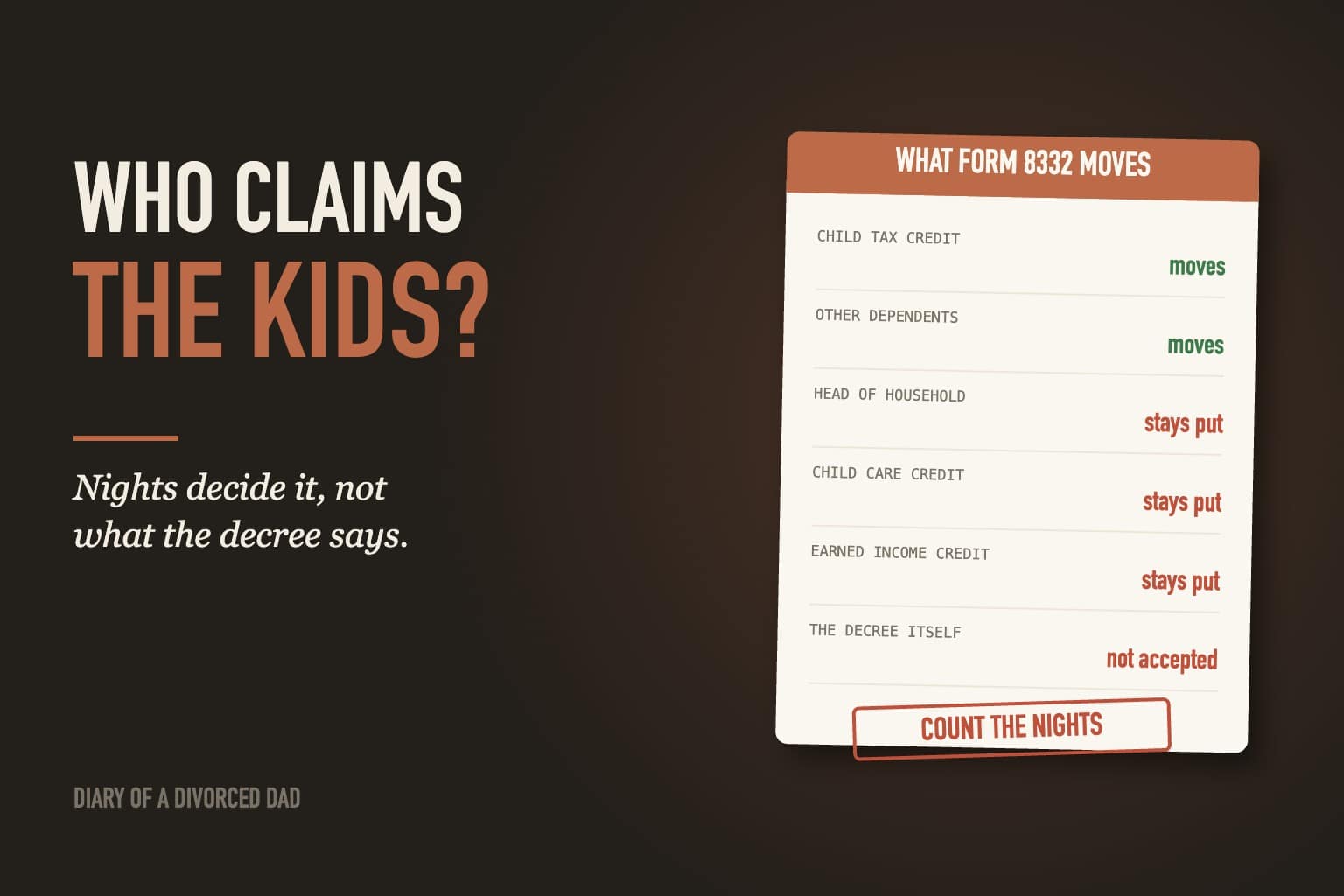
- Form 8332 moves the Child Tax Credit to you. It does not move head of household status, the child care credit or the earned income credit. Those stay with the other parent.
- Child support is never deductible and never taxable. Alimony in divorces finalized after 2018 is the same.
- If you both claim the same child, the second return gets rejected. The fix is paper filing with documentation, not arguing with the IRS by phone.
The first tax season after a divorce is where men discover that the agreement they signed and the rules the IRS applies are two different things. The decree says you claim the kids in odd years. The IRS does not care what the decree says. That gap costs people thousands.
Here is what actually governs it.
December 31 decides your filing status
You are treated as married for the whole year if you were still married on the last day of it, and single for the whole year if the divorce was final by then. There is no proportion, no splitting the year.
- Divorce final on or before December 31: you file single, or head of household if you qualify.
- Still married on December 31: married filing jointly or married filing separately, even if you have lived apart for ten months.
- Separated but not divorced: you may still be able to file as head of household if you lived apart for the last six months of the year and meet the other tests.
- Timing matters. If a decree is going to land in late December or early January, it is worth asking which side of the line is better for both of you before you sign.
Who gets to claim the children
The default rule is nights, not money. The custodial parent for IRS purposes is the one the child spent more nights with during the year. That parent claims the child unless they sign the right form.
A divorce decree is not enough
For agreements after 2008, the IRS will not accept a divorce decree or a custody order as proof of your right to claim a child. You need a signed Form 8332 from the other parent, attached to your return. If the decree says you claim the children and she will not sign, that is a contempt issue for family court. The IRS will simply reject your claim.
What Form 8332 actually transfers
This is the most misunderstood thing in divorced parent taxes, and it costs men real money every year.
| Tax benefit | Moves with Form 8332? |
|---|---|
| Child Tax Credit | Yes, moves to the noncustodial parent |
| Credit for Other Dependents | Yes |
| Head of household status | No, stays with the custodial parent |
| Earned Income Tax Credit | No, stays with the custodial parent |
| Child and Dependent Care Credit | No, stays with the parent the child lived with |
| Health coverage and medical expenses | Follows its own rules, often claimable by whoever paid |
So a father who signs an agreement to claim one child in alternating years does not become head of household in those years. He gets the Child Tax Credit and nothing else. Knowing that before you negotiate is worth more than arguing about it afterward.
Head of household, and why it matters more than the credit
Head of household gives a bigger standard deduction and wider brackets than filing single. To claim it you generally need to be unmarried at year end, pay more than half the cost of keeping up a home, and have a qualifying child live with you for more than half the year.
- More than half the year is the hurdle. Every other weekend is nowhere close. A true equal schedule is borderline and depends on the night count.
- Two children can mean two filers. Where there are two or more children and each parent has one living with them for more than half the year, both parents can sometimes qualify.
- Count nights properly. Keep the calendar. In a dispute, the parent with the better records wins.
- It is not transferable. No form, no agreement and no judge can move head of household to the other parent.
Support and alimony
- Child support is invisible to the IRS. The payer gets no deduction, the recipient reports no income. It is treated as money you were always going to spend on your children.
- Alimony depends on the date. For agreements executed after December 31, 2018, alimony is not deductible by the payer and not taxable to the recipient. Older agreements keep the old treatment, where it was deductible and taxable, unless they are modified and the modification adopts the new rules.
- Do not relabel support as alimony to get a deduction. The rules on what counts are specific, and payments tied to a child related event can be recharacterized.
- Paying expenses directly rather than through the order usually gets you no tax benefit and no credit toward what you owe. See why cash and side arrangements backfire.
The house, the retirement accounts, and the hidden tax bill
Property moved between spouses as part of a divorce generally transfers with no immediate tax. The trap is that the original cost basis travels with it, so two assets of the same value can be worth very different amounts after tax.
- Taking the house is not the same as taking cash. The gain on sale is measured from the original purchase price, not from the value used in the settlement.
- You can exclude up to 250,000 dollars of gain on a main home as a single filer, or 500,000 while married filing jointly, if you meet the ownership and use tests. Timing a sale around the divorce date can be worth a lot.
- Retirement accounts need a QDRO to be split without triggering tax and the early withdrawal penalty. Cashing out instead is the most expensive mistake in this whole area. More in rebuilding your finances after divorce.
- A taxable brokerage account with large unrealized gains is worth less than the same number in cash. Negotiate on after tax value, not headline value.
When you both claim the same child
It happens constantly, usually by accident in the first year. The IRS does not referee it in advance. The first return filed goes through and the second is rejected electronically.
- File on paper if you are the one rejected, with Form 8332 if you have it, and whatever evidence supports your claim.
- Expect a letter asking both parents to prove it, and expect it to take months.
- The tiebreaker is the parent the child lived with more nights. If the nights are equal, it goes to the parent with the higher adjusted gross income.
- Keep a calendar of overnights all year. It sounds obsessive until the year you need it.
- Then fix the order so this does not repeat, and put the Form 8332 obligation into it in writing.
Before you file
- Your divorce decree and any custody order, so your preparer can read what was agreed.
- A signed Form 8332 if you are claiming a child you do not have the majority of nights with.
- Your overnight count for the year.
- Records of what you paid: support, medical, insurance, tuition, child care.
- Closing documents if the house sold, and the QDRO if retirement was split.
- Last year’s return, which is what your preparer will compare against.
If you are self employed on top of all this, the income question gets its own complications, and how courts treat self employed income is worth reading alongside. For the month to month picture, the one page budget and two homes, one paycheck cover where the money actually goes.
None of this is exotic, and almost all of it is decided before you file, in the agreement. Read the tax paragraphs of your decree the way you would read a contract, because that is what they are.
Been through this? The most useful thing on this site is what other dads have already survived. If you have a story that would help the man reading this at midnight, send it to us here. You can stay anonymous.
If you want a simple place to start, our free 7-Day Divorced Dad Reset gives you one small, doable step a day.
About Diary of a Divorced Dad
Diary of a Divorced Dad is a community of fathers rebuilding their lives after divorce. Our articles are written and reviewed by dads who have actually been through it. See how we work.
This is general information, not tax or legal advice. Tax rules change and the right answer depends on your custody schedule, your income and your decree. Talk to a CPA or a tax professional who handles divorced parents, and to your family law attorney about what the agreement requires.
Frequently asked questions
Who claims the children on taxes after a divorce?
By default the parent the children lived with for more nights during the year. The other parent can claim a child only if the custodial parent signs Form 8332 releasing the claim, and that form has to be attached to the return.
Does my divorce decree decide who claims the kids?
Not for the IRS. For agreements after 2008 the IRS requires Form 8332 rather than a decree or custody order. If the decree says you claim a child and the other parent will not sign, that is enforceable in family court, not with the IRS.
Can I file as head of household if I pay child support?
Paying support does not qualify you. Head of household generally requires being unmarried at year end, paying more than half the cost of keeping up your home, and having a qualifying child live with you for more than half the year.
Is child support tax deductible?
No. Child support is not deductible by the parent paying it and is not taxable income for the parent receiving it.
Is alimony still deductible?
Only for agreements executed on or before December 31, 2018. For divorces finalized after that date, alimony is neither deductible by the payer nor taxable to the recipient, unless an older agreement is modified in a way that adopts the newer rules.
What happens if both parents claim the same child?
The second electronically filed return is rejected. The second parent must file on paper with supporting documents, and the IRS applies a tiebreaker: more overnights wins, and if the nights are equal, the higher adjusted gross income wins.