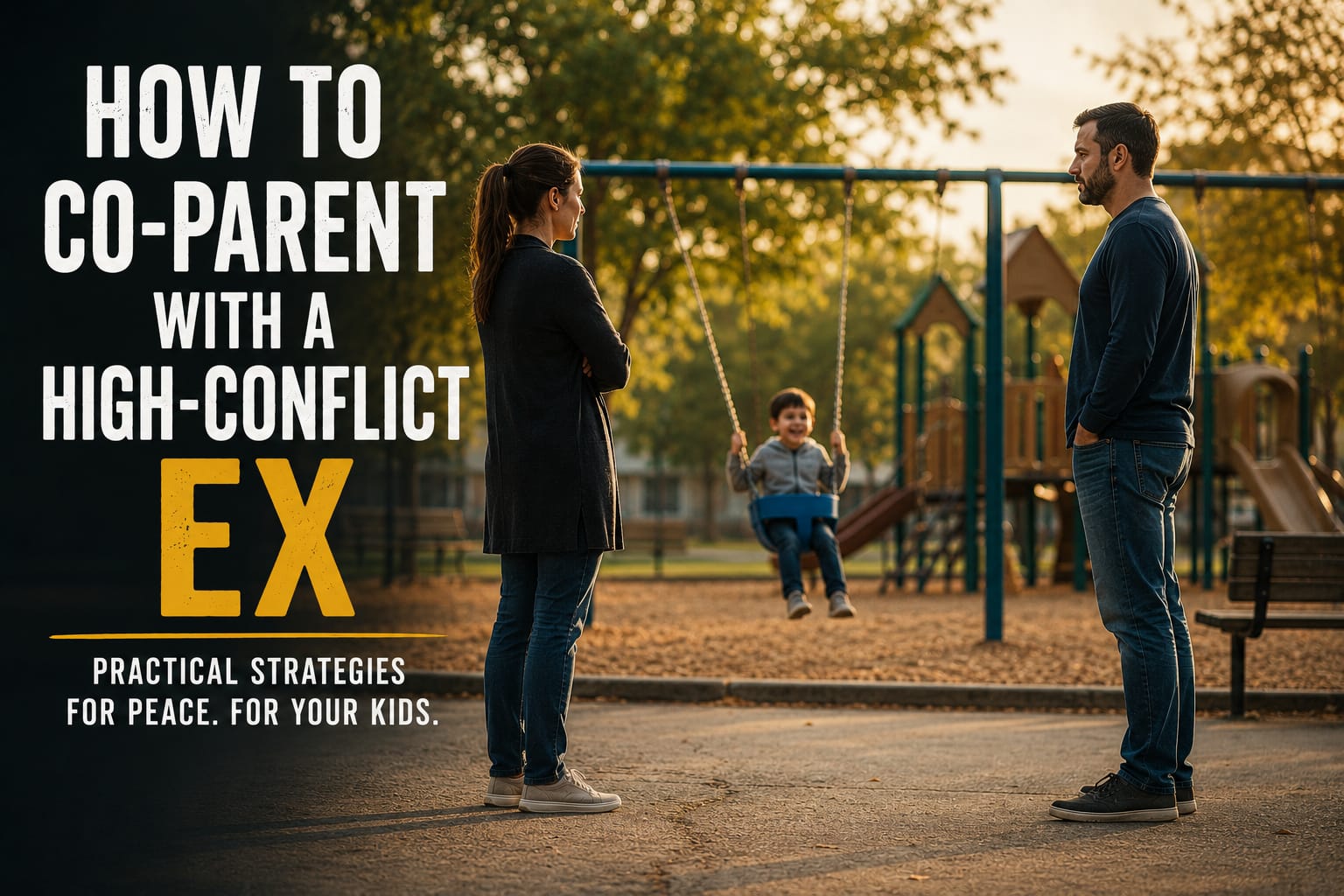
How to Co-Parent With a High-Conflict Ex
When you imagined raising your children, you probably pictured birthdays, vacations, school plays, and cheering from the sidelines together.
You probably didn’t imagine trying to coordinate pickup times through tense text messages or worrying that every conversation might turn into an argument.
For many divorced dads, the hardest part of divorce isn’t the paperwork.
It’s learning how to parent alongside someone who sees the world very differently than you do.
If your ex seems to create conflict at every opportunity, you’re not alone.
The goal isn’t to change them.
The goal is to protect your children and protect your own peace.
When the distance from your children feels especially difficult, read What to Do When You Miss Your Kids After Divorce.
You Can’t Control Someone Else
One of the biggest frustrations after divorce is realizing you have almost no control over another person’s choices.
You can’t control what they say.
You can’t control how they parent during their time.
You can’t control their attitude.
You can control your response.
That’s where your energy belongs.
Every ounce of emotional energy spent trying to change someone else is energy taken away from your children.
Put Your Kids at the Center
Whenever conflict begins, ask yourself one question:
“Does this help my child?”
Not:
“Am I right?”
Not:
“Can I prove my point?”
Children deserve parents who protect them from adult disagreements whenever possible.
The more they stay out of the middle, the healthier they’ll usually be.
Never ask them to carry messages.
Never ask them to take sides.
And never make them feel guilty for loving both parents.
Love isn’t a competition.
Keep Communication Brief and Respectful
Not every text message deserves a paragraph.
Many parenting experts recommend keeping communication:
- Brief
- Informative
- Friendly
- Focused
If the conversation starts drifting toward old arguments or personal attacks, gently steer it back to the children.
Think of communication like a business meeting.
Professional.
Calm.
Purposeful.
Choose Peace Over Winning
Sometimes you’ll be right.
Sometimes you’ll know you’re right.
And sometimes proving you’re right simply isn’t worth the emotional cost.
Ask yourself:
“Will this matter in a year?”
If the answer is no, consider letting it go.
Peace isn’t weakness.
It’s wisdom.
When Parallel Parenting Makes More Sense
Not every situation allows healthy co-parenting.
If communication constantly turns hostile or stressful, parallel parenting may be a healthier option.
Parallel parenting focuses on reducing direct interaction while allowing each parent to care for the children during their own parenting time.
The goal isn’t friendship.
The goal is reducing conflict.
Sometimes less communication creates a calmer environment for everyone.
Take Care of Yourself, Too
Co-parenting stress can slowly wear you down.
Find healthy outlets.
- Exercise
- Talk with trusted friends
- Journal
- Pray
- See a counselor if needed
You can’t pour into your children if your own emotional tank is empty.
Taking care of yourself isn’t selfish.
It’s part of being a good father.
Your Children Notice More Than You Think
Children watch how adults handle conflict.
They notice whether you stay calm.
They notice whether you keep your promises.
They notice whether your home feels peaceful.
You may not be able to control what happens in the other household.
But you can make yours a place where your children feel safe, loved, and accepted.
That’s something they’ll carry for the rest of their lives.
Final Thoughts
Co-parenting with a high-conflict ex isn’t easy.
Some days will test every ounce of your patience.
But remember why you’re doing it.
Not for your ex.
Not to win.
For your children.
Every calm response.
Every mature decision.
Every moment you choose peace over conflict…
Shows your kids what strength really looks like.
Frequently Asked Questions
What is a high-conflict co-parent?
A high-conflict co-parent is someone whose interactions frequently involve arguments, blame, or ongoing disputes. The focus should remain on creating a stable environment for your children rather than trying to change the other person’s behavior.
What is parallel parenting?
Parallel parenting is a structured approach where divorced parents minimize direct interaction while each independently cares for the children during their parenting time. It can be helpful in high-conflict situations.
Should I respond to every angry text from my ex?
Not necessarily. Respond when it’s about your children or requires a response. Keeping communication brief, respectful, and focused on parenting often helps reduce unnecessary conflict.
Dad’s Note
One lesson took me far too long to learn.
You don’t have to attend every argument you’re invited to.
Sometimes the strongest thing a father can do is stay calm, love his kids well, and let his character speak louder than his frustration.
Your children are watching.
Make sure they see the kind of man you hope they’ll become.
Protect Their Stability
Healthy co-parenting isn’t about having the perfect relationship with your ex. It’s about giving your children the stability they deserve.
At Diary of a Divorced Dad, you’ll find practical advice, honest stories, and encouragement for every stage of life after divorce. If you’re looking for a deeper roadmap, The Divorced Dad’s Guidebook is packed with tools to help you become the father your kids need.
Related Articles
About Diary of a Divorced Dad
Diary of a Divorced Dad is a community of fathers rebuilding their lives after divorce. Our articles are written and reviewed by dads who have actually been through separation, co-parenting, and dating again — sharing what genuinely helped. See how we work.
This is lived experience and general information, not legal, financial, or mental-health advice. For your situation, please talk to a qualified professional.

Recommended reading
The Divorced Dad’s Survival Guide
A practical playbook for co-parenting, money, dating, and your mental health after divorce. By Oliver Ahn.
Get the book on Amazon →