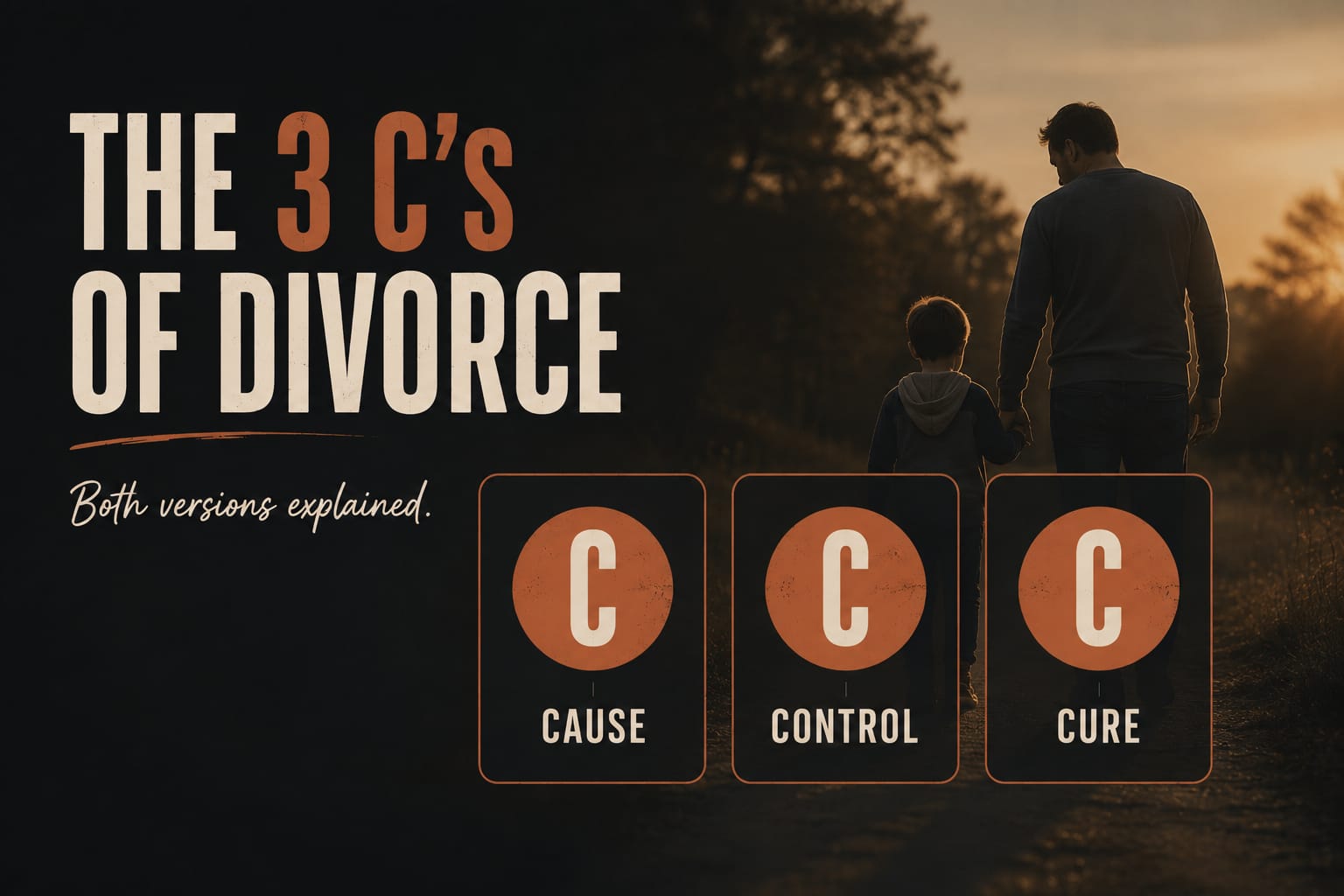
What Are the 3 C’s of Divorce? Both Versions Explained
Updated September 14, 2026
Key takeaways
- The phrase is used two different ways, and both are useful.
- For kids: you did not Cause it, you cannot Control it, you cannot Cure it.
- For parents: Communication, Cooperation, Compromise, the three habits of workable co-parenting.
- If your ex will not cooperate, focus on what you control and switch to parallel parenting.
You will hear “the 3 C’s of divorce” thrown around by counselors, lawyers, and parenting classes. Confusingly, it means two different things depending on who is saying it. Both are worth knowing, so here is a straight explanation of each.
The 3 C’s for children of divorce
This version exists because kids almost always take on guilt that was never theirs. The 3 C’s are a simple script to give them, repeatedly, until it sinks in.
1. You did not Cause it
Children, especially under about age ten, often quietly believe they caused the divorce. If they had behaved better, gotten better grades, not fought with their sibling. Say the words out loud: this is an adult decision between mom and dad, and nothing you did caused it. Say it more than once. They will need to hear it again.
2. You cannot Control it
Many kids will try to fix it. They might play matchmaker, act out to force you together, or become suddenly perfect hoping it changes something. They need to hear that this is not something they can change, kindly but clearly, so they can stop carrying it.
3. You cannot Cure it
This one is about their role. It is not their job to make you happy, to comfort you, or to hold the family together. Kids who take on the caretaker role often struggle later. Let them be kids.
For more on protecting them through it, see what age divorce is most damaging to a child.
The 3 C’s of co-parenting
The other version is aimed at the adults. It is the short list of what makes two households work.
1. Communication
Clear, businesslike, and about the kids only. Keep it in writing when things are tense, keep it short, and leave the history out of it. Think of it like emailing a colleague you do not particularly like but have to work with.
2. Cooperation
Show up on time, stick to the schedule, and give a heads up when something changes. Cooperation is not friendship. It is reliability. Doing what you said you would do buys enormous goodwill over time.
3. Compromise
Pick your battles. Fighting over bedtime by fifteen minutes costs you the credibility you will need for the decisions that actually matter. Save your energy for school, health, and safety.
Practical tools help a lot here. Our guide to the best co-parenting apps covers apps that handle schedules, expenses, and documented messaging.
What if your ex refuses to play along?
This is the honest gap in the advice. The 3 C’s assume two cooperative adults. Plenty of dads do not have that.
If your ex will not communicate reasonably or uses cooperation as a weapon, stop trying to force traditional co-parenting and switch to parallel parenting: minimal contact, everything in writing, firm boundaries, and each household running independently. Our full guide on co-parenting with a narcissist or high-conflict ex walks through exactly how.
Either way, the 3 C’s for your kids still apply. You can deliver those on your own, in your own house, no cooperation required.
The bottom line
Whichever version someone means, the point is the same: keep your kids out of the middle and keep the adult stuff between adults. Tell them clearly it was not their doing. Then keep your side of the co-parenting street clean, whether or not your ex keeps theirs.
For the bigger picture, start with our complete guide on how to get through a divorce as a man.
For a more hopeful picture of what co-parenting can become, read Co-Parenting Like You Love Each Other.
Frequently asked questions
What are the 3 C’s of divorce?
The phrase is used two ways. For children, the 3 C’s are: you did not Cause it, you cannot Control it, and you cannot Cure it. For parents, the 3 C’s of healthy co-parenting are Communication, Cooperation, and Compromise. Both versions are worth knowing.
What are the 3 C’s for children of divorce?
Cause, Control, Cure. Children need to hear clearly that they did not cause the divorce, they cannot control whether their parents get back together, and it is not their job to fix or cure the family. It relieves the guilt kids often carry silently.
What are the 3 C’s of co-parenting?
Communication, Cooperation, and Compromise. Communicate clearly and only about the kids, cooperate on schedules and big decisions, and compromise on the small stuff so the important things go smoothly.
What if my ex will not follow the 3 C’s?
You cannot force cooperation. When one parent refuses, most dads shift to parallel parenting: low contact, everything in writing, and firm boundaries. You focus on the parts you control, which are your own consistency and your relationship with your kids.
Are there other versions of the 3 C’s?
Yes. Some coaches and courts use variations like Consistency, Calm, and Communication. The wording differs, but the idea is the same: keep kids out of the middle, keep contact businesslike, and stay steady.
About Diary of a Divorced Dad
Diary of a Divorced Dad is a community of fathers rebuilding their lives after divorce. Our articles are written and reviewed by dads who have actually been through it. See how we work.
This is general information and lived experience, not legal or psychological advice. Different counselors and courts use slightly different wording for the 3 C’s.