Child Support When You Are Self-Employed
Key takeaways
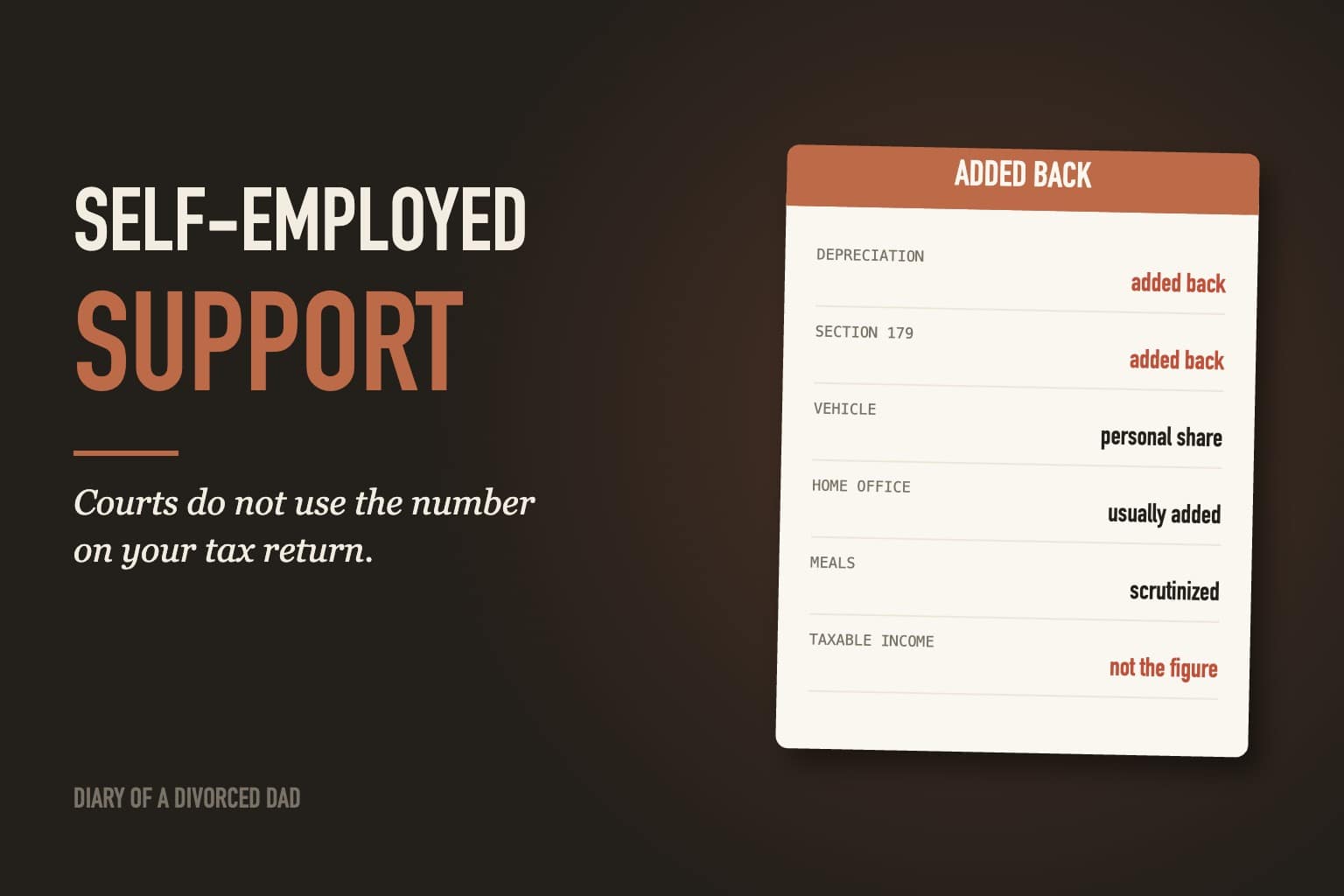
- Courts do not use your taxable income. They start from gross receipts and add back deductions that reduced your taxes but did not reduce your lifestyle.
- Expect depreciation, the vehicle, the phone, meals, home office and anything run through the business to be added back to your income.
- For variable earners, most courts average two or three years rather than using your worst month or your best.
- A sudden drop in reported income right before a hearing is the oldest move there is, and judges impute income when they see it.
- Clean books and consistent pay are your best defense. Messy books mean the other side gets to estimate, and their estimate will not be kind.
If you work for someone else, child support is arithmetic. A pay stub goes into a formula and a number comes out. If you are self employed, the number is argued about, and the argument is usually the most expensive part of the whole divorce.
The reason is simple. The tax code rewards you for minimizing income. Family court does the opposite: it tries to find the income you actually have.
What counts as income when you own the business
Start from the top line, not the bottom one. Courts generally take gross receipts and subtract only the expenses they consider ordinary, necessary and genuinely required to produce the income. Plenty of legitimate tax deductions do not survive that test.
| Deduction on your return | How family court usually treats it |
|---|---|
| Depreciation on equipment or vehicles | Commonly added back, because it is a paper expense rather than cash leaving your pocket |
| Section 179 write offs | Usually added back or spread out, for the same reason |
| Vehicle costs | Business portion allowed, personal use added back |
| Cell phone and internet | Split, with the personal share added back |
| Home office | Often added back where you would be paying for the home anyway |
| Meals and entertainment | Scrutinized closely, frequently added back |
| Wages to a new partner or family member | Added back if the court thinks the role is not real |
| Retained earnings in an S corp | May be counted where you control whether to distribute them |
None of that means you did anything wrong on your taxes. It means the two systems ask different questions. Your accountant asks what you are allowed to deduct. The judge asks what you had available to spend.
If your income swings
Commission, seasonal trades, freelance work and anything tied to the weather or the market produce a different fight: not what counts, but which year counts.
- Averaging is the normal answer. Most courts look at two or three years and use the average rather than the most recent twelve months.
- Bring the whole picture. If you are arguing that last year was unusually good, you need the years around it to prove that.
- Seasonal does not mean lower. A roofer who earns nothing in February and a fortune in July earns a yearly figure, and that is what will be used.
- Ask for a review provision. Some orders allow for an annual true up based on tax returns, which fits variable income better than a fixed monthly figure.
What the other side will ask for
Expect all of it, and expect to produce it. Fighting disclosure makes you look like a man with something to hide, which is the impression you most need to avoid.
- Personal and business tax returns, usually three to five years.
- All 1099s, K-1s and W-2s.
- Profit and loss statements and balance sheets.
- Complete business and personal bank statements, often two years or more.
- Merchant processor statements, which are hard to argue with.
- Your bookkeeping file, including QuickBooks access in some cases.
- Credit card statements, to show what the business paid for.
Cash businesses, and the lifestyle test
If you work in a trade where customers pay cash, understand how this plays out. Nobody has to prove what you earned. They only have to show that what you reported cannot support how you live.
- Bank deposit analysis. Total deposits versus reported income. The gap is the argument.
- Lifestyle analysis. Rent, truck payments, trips, tuition, the boat. If the spending exceeds the income, a court can find the income is understated.
- Imputed income. Where the court cannot establish a figure, it assigns one based on what you appear capable of earning.
- It can get worse than money. Testimony about unreported income creates problems beyond family court, which is a conversation for your attorney, not for a blog.
The move that backfires
Reducing your income right before a filing, taking fewer jobs, paying yourself less, or parking money in the business is the most recognizable tactic in family court. Judges respond by imputing income, which leaves you with an order based on money you are no longer earning. Nothing on this page costs men more than that.
What to do if you are self employed and heading for this
- Get your books clean and current. A tidy P and L does more for you than any argument.
- Pay yourself consistently, through the business, on a schedule.
- Separate personal spending from business accounts now, so the two are not tangled when someone reads your statements.
- Keep running the business normally. Do not turn down work.
- Expect a forensic accountant in a serious case, and budget for your own if the numbers are large.
- Ask your attorney about an income averaging provision and an annual review clause.
If the order is already unaffordable
Variable income means some years the order genuinely does not fit. The rules for that are the same as everyone else’s, and the timing is everything: file for modification the day the income changes, because arrears cannot be reduced retroactively. What to do when you cannot afford child support covers it, and how child support is calculated explains the formula you are arguing inside.
For the household side of a variable income, the one page budget works better when built on your average month rather than your best one.
Been through this? The most useful thing on this site is what other dads have already survived. If you have a story that would help the man reading this at midnight, send it to us here. You can stay anonymous.
If you want a simple place to start, our free 7-Day Divorced Dad Reset gives you one small, doable step a day.
About Diary of a Divorced Dad
Diary of a Divorced Dad is a community of fathers rebuilding their lives after divorce. Our articles are written and reviewed by dads who have actually been through it. See how we work.
This is general information, not legal, tax or accounting advice. How income is determined for self employed parents varies significantly by state and by judge, and the stakes are high enough to justify a family law attorney and, where the numbers are large, a forensic accountant.
The other half of the money question is the filing itself. Taxes after divorce covers who claims the children and what Form 8332 does and does not move.
Frequently asked questions
How is child support calculated for self employed parents?
Courts generally start from gross business receipts and subtract only expenses they consider genuinely necessary to produce income. Deductions such as depreciation, vehicle costs, home office and meals are often added back, so the support figure is usually higher than your taxable income suggests.
Does depreciation count as income for child support?
In most states, effectively yes. Depreciation reduces taxable income without taking cash out of your pocket, so family courts routinely add it back when working out what you have available to pay.
What if my income changes every year?
Courts commonly average two or three years rather than using a single year. Bring the full picture, and ask your attorney about an annual review or true up provision, which fits variable income better than a fixed figure.
What happens if I under report my income?
The other side does not have to prove your earnings. They can use bank deposit analysis and a lifestyle comparison to show your reported income cannot support how you live, and the court can then impute income to you.
Can I lower support by taking less work?
No, and attempting it usually makes things worse. Courts impute income based on earning capacity when they believe a reduction was voluntary, which leaves you with an obligation calculated on money you are no longer bringing in.
What records will I have to produce?
Expect personal and business tax returns, 1099s and K-1s, profit and loss statements, several years of business and personal bank statements, merchant processor records and often your bookkeeping file.