Military Divorce: What Service Members Need to Know
Key takeaways
- Military divorce runs on the same state rules as any divorce, with a federal layer on top: pension division, benefits and legal protections while you serve.
- The 10/10 rule is about who writes the check, not who gets the money. It decides whether DFAS pays your ex directly, not whether she is entitled to a share.
- The 20/20/20 rule is the benefits one. Twenty years of marriage, twenty of service, twenty overlapping, and a former spouse keeps full commissary, exchange and TRICARE.
- Deployment cannot be used to take custody permanently. Most states now have protections, and you can usually delegate your parenting time to family while deployed.
- Your branch requires interim support before any court order exists. Ignoring that is a command problem, not just a legal one.
Everything written for divorcing service members is either a recruiting-style article with no detail or a law firm page built to generate calls. Here is the plain version, with the parts that actually catch men out.
The pension, and the two rules everyone confuses
Military retired pay can be divided as marital property under the Uniformed Services Former Spouses Protection Act. State law decides how much, exactly as it does with a civilian pension.
| Rule | What it actually governs |
|---|---|
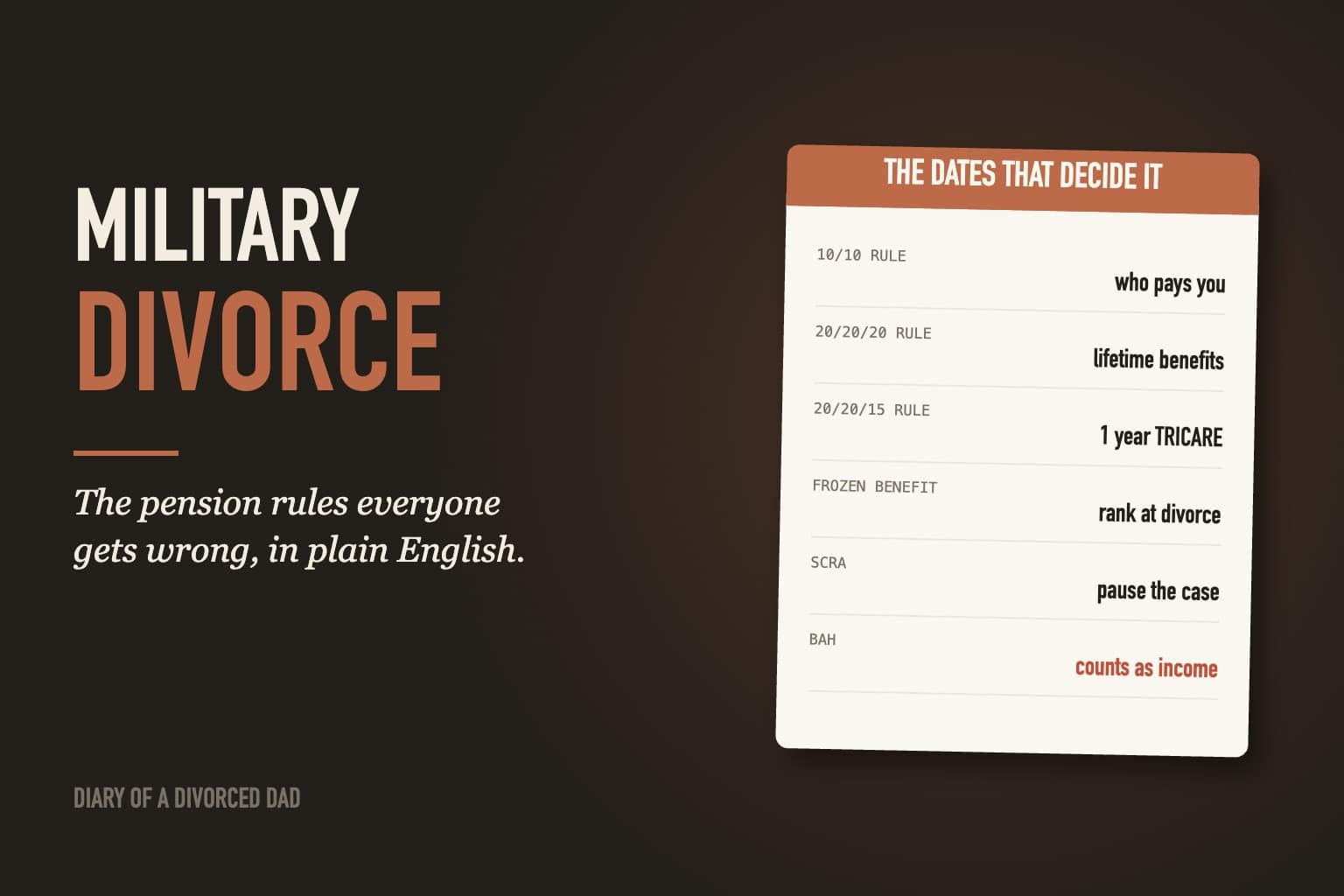
| The 10/10 rule | Ten years of marriage overlapping ten years of creditable service. If you meet it, DFAS pays the former spouse directly. If you do not, she may still be awarded a share, you just have to pay her yourself. |
| The 20/20/20 rule | Twenty years of marriage, twenty years of service, twenty years of overlap. The former spouse keeps full commissary, exchange and TRICARE benefits for life. |
| The 20/20/15 rule | Same, with fifteen years of overlap. Transitional TRICARE for about a year, no commissary or exchange. |
| The frozen benefit rule | For divorces after December 2016, the divisible amount is generally calculated on your rank and years of service at the time of divorce, not at retirement. Promotions you earn afterward are usually yours. |
That last one is the change most men have not heard about, and it matters enormously if you are mid career. It means the share is pegged to where you were on the day of the divorce rather than where you end up.
Custody when you can be sent anywhere
This is the fear, and the law has moved in your favor over the last decade.
- Deployment is not supposed to cost you custody. Most states have military parent protection laws preventing a temporary deployment order from becoming permanent, and requiring the arrangement to revert when you return.
- You can usually delegate your parenting time. Many states allow your time to go to a grandparent, a sibling, or a stepparent while you are gone, which keeps your children connected to your side of the family.
- Get a family care plan into the order. Who has the children, who drives them, how video calls work, and what happens the week you return.
- Protect contact in writing. Specify video call times that account for the time difference and operational reality, rather than leaving it to goodwill.
- Put the return in the order. The single most contested moment is the handoff back after a deployment, and the fix is a clause that already says what happens.
For the underlying schedule patterns, the 50/50 schedules that actually work still apply, with the deployment clauses layered on top.
Support, BAH, and the rules your branch has anyway
Here is the part that surprises people: before any court is involved, your service already requires you to support your family. Each branch has its own regulation, and the amount is typically tied to your Basic Allowance for Housing.
- Interim support is a command matter. Failing to pay what the regulation requires can bring administrative action, separate from anything a judge does.
- BAH generally counts as income when a state court calculates child support, even though it is not taxed.
- So do most allowances. BAS, special pays and bonuses often count. Expect your gross military compensation to be used rather than your taxable income.
- Involuntary allotments can be started once there is an order, taking support straight from your pay.
If the number itself is the question, how child support is calculated explains the formulas, and if it is already unaffordable, what to do when you cannot pay is the one to read today rather than next month.
The protection most service members forget
The Servicemembers Civil Relief Act lets you ask a court to pause proceedings when your duties genuinely prevent you from participating. A first stay of at least ninety days is generally available, and extensions can be requested.
- It is a shield against a default judgment entered while you are deployed or in training.
- It is not a way to stall a case you simply do not want to attend, and judges can tell the difference.
- You need a statement showing how your duties prevent appearing and when you will be available.
- Legal assistance on base can help you file it, usually at no cost.
Use the legal help you have already paid for
Base legal assistance is free, familiar with military-specific rules, and underused. They generally cannot represent you in a contested divorce, but they can explain the pension rules, review a proposed agreement, and point you at the civilian specialists.
- Start with legal assistance before you hire anyone.
- When you do hire, pick someone who handles military divorces specifically. USFSPA and the frozen benefit rule are not general practice knowledge.
- Bring your LES statements, your service record and the dates of marriage and service. The overlap dates decide almost everything.
Where to start if you are facing this now
- Write down three dates: marriage, start of service, and separation. Those decide which rules apply to you.
- Book base legal assistance this week.
- Check your branch support regulation and make sure you are compliant now, before anyone files.
- Draft the deployment clauses you want in the parenting plan rather than waiting for them to be offered.
- Keep every LES, order and travel document in one place.
The rest of it is an ordinary divorce, with the same money and parenting questions everyone else faces. How to get through a divorce as a man covers the human part, which the regulations do not.
Been through this? The most useful thing on this site is what other dads have already survived. If you have a story that would help the man reading this at midnight, send it to us here. You can stay anonymous.
If you want a simple place to start, our free 7-Day Divorced Dad Reset gives you one small, doable step a day.
About Diary of a Divorced Dad
Diary of a Divorced Dad is a community of fathers rebuilding their lives after divorce. Our articles are written and reviewed by dads who have actually been through it. See how we work.
This is general information, not legal advice. Military divorce combines federal rules with state law, and the details depend on your branch, your dates of service and where you file. Speak to base legal assistance and to a family law attorney who handles military cases.
Frequently asked questions
What is the 10/10 rule in a military divorce?
It requires ten years of marriage overlapping ten years of creditable service, and it determines whether DFAS pays the former spouse her share of retired pay directly. It does not decide whether she is entitled to a share, which is a question of state property law.
What is the 20/20/20 rule?
Twenty years of marriage, twenty years of service and twenty years of overlap. A former spouse who meets all three keeps full commissary, exchange and TRICARE benefits. With only fifteen years of overlap, the 20/20/15 rule gives transitional TRICARE for roughly a year.
Can I lose custody because I might deploy?
Deployment alone should not cost you custody. Most states have military parent protection laws that prevent a temporary order from becoming permanent and require the arrangement to revert when you return. Many also allow you to delegate your parenting time to family while you are away.
Does BAH count as income for child support?
In most states, yes. Housing and subsistence allowances are generally included even though they are not taxed, so support is usually calculated on gross military compensation rather than taxable pay.
Do I have to pay support before a court orders it?
Your branch requires it. Each service has a regulation setting interim support, commonly tied to BAH, and failing to comply can bring command or administrative consequences independent of the court case.
Can I pause a divorce case while deployed?
Often yes. The Servicemembers Civil Relief Act allows a stay, generally at least ninety days, where your duties genuinely prevent you from participating. You must explain how service prevents your appearance and when you will be available.