My Teenager Will Not Come to My House: What to Do
Key takeaways
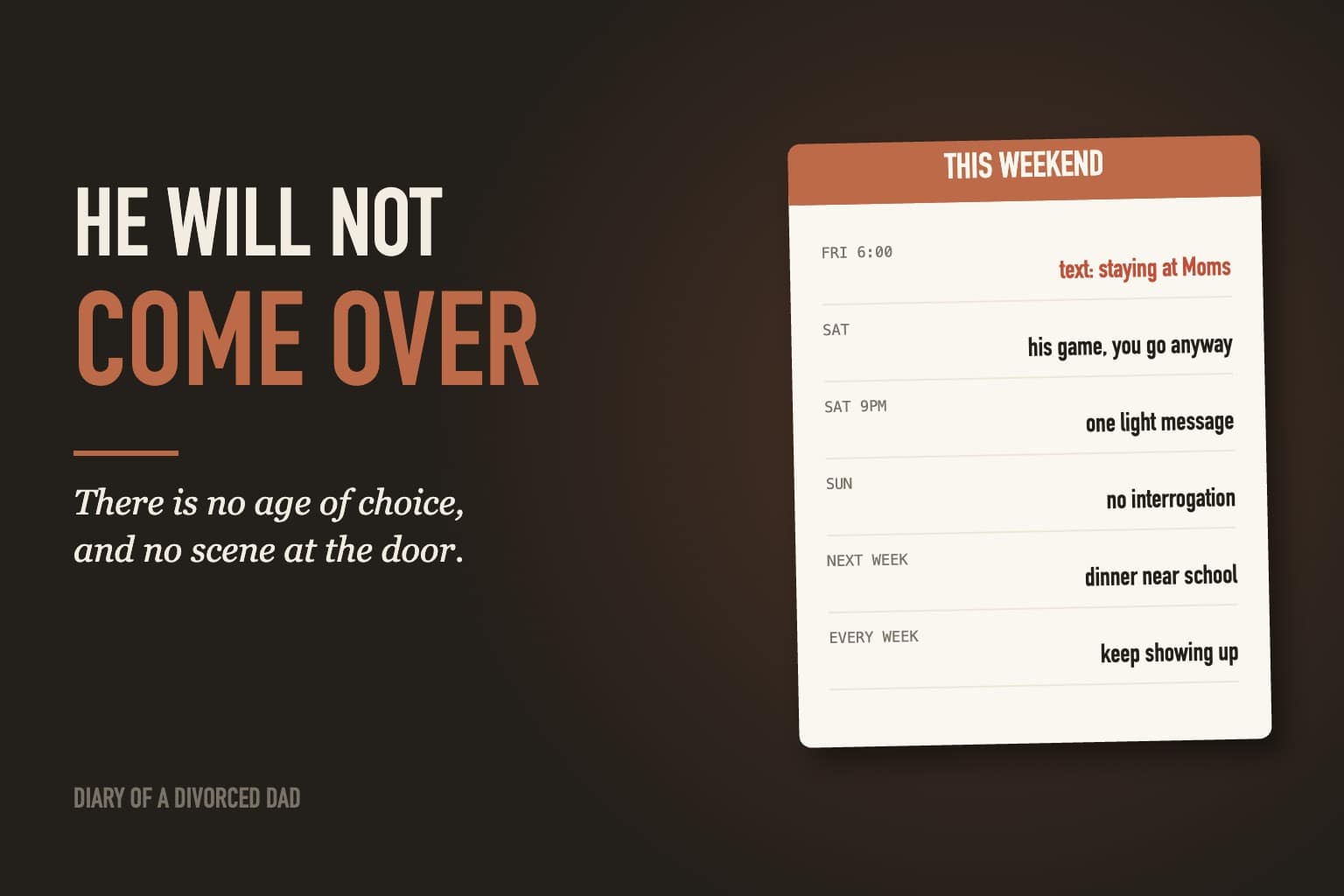
- No state lets a child decide on their own. The age of choice is a myth. Courts weigh an older teenager’s preference, they do not hand them the decision.
- The order binds you and their mother, not the child. You are expected to make them available, and “he refused” is rarely a complete defense.
- Do not fight it at the door. Forcing a scene in front of a teenager costs you more than the missed weekend.
- Most refusals are ordinary: friends, sport, a girlfriend, boredom at your place, or a feeling of being managed. Alienation exists and is rarer than the internet suggests.
- Keep showing up, document every attempt, and shift to their life instead of your schedule. Teenagers come back to the father who stayed available without making it heavy.
It usually starts small. A cancelled weekend for a tournament. Then a birthday party. Then a text that says I just want to stay at Mom’s this week. Somewhere in there a father realizes his fifteen year old is not coming, and nobody has told him what he is allowed to do about it.
What the law actually says
Three things, and the internet gets all of them wrong.
- There is no magic age. No state hands a child the right to opt out of a custody order. Some states require courts to consider a child’s preference from a certain age, often around twelve to fourteen, and a few give it real weight for older teens. Considering it is not obeying it.
- The order controls the parents. Your obligation is to make the child available and to encourage the visit. Her obligation is the same in reverse.
- Judges are realistic about teenagers. No court expects a father to physically carry a sixteen year old to a car. What they do expect is that neither parent is quietly encouraging the refusal, and that both are seen trying.
What never works
Do not stop paying support because your teenager is refusing visits. The two are legally unconnected, it will not pressure anyone, and it hands the other side an easy win. Withholding support turns your genuine grievance into your legal problem.
Figure out which refusal this is
The response depends entirely on the cause, and men often assume the worst one.
| What is probably happening | What it looks like |
|---|---|
| Normal teenage life | They skip your weekend for a party, then come willingly the next time. They would also skip their mother if she had the weekend. |
| Your house is boring | No friends nearby, no wifi worth having, nothing to do, a bedroom that still looks like it did when they were nine. |
| Loyalty pressure | They seem anxious rather than hostile, apologize a lot, or repeat adult phrases that are not theirs. |
| A specific grievance | Something you said, a new partner, a rule, a missed event. Often fixable, usually never stated directly. |
| Alienation | A sudden, total rejection with no proportionate cause, scripted language, hostility toward your whole family, and no guilt about any of it. |
The last one is real and serious, and it is also the one men reach for first. If a teenager is still affectionate on the phone but keeps choosing their friends, that is not alienation, that is being fifteen.
What to do in the moment
- Do not argue at the door. You will not win, and your child will remember the scene for years.
- Say the warm thing and leave the door open. “No problem. I miss you. I am around all weekend if you change your mind.”
- Go anyway if there is an event. Turn up at the game. Be pleasant. Leave without a lecture.
- Do not interrogate afterward. One light question, then silence. Pressure confirms whatever they are being told about you.
- Never make them deliver the message. Take it up with their mother in writing, not through the kid.
What to do over the next three months
This is the part that works, and it is slower than anybody wants.
- Move to their territory. Dinner near their school, a lift to practice, an hour at a coffee shop. Teenagers accept small, low stakes contact long before they accept a weekend.
- Use the car. Side by side, no eye contact, late at night, is where teenagers talk. Every father who has got through to one knows this.
- Fix the house problem. Wifi, a door that closes, somewhere a friend can sleep over, food they like. A teenager needs a room, not a bunk bed in the corner. The apartment checklist covers the basics.
- Stop competing with their social life. Offer to drive them and their friends somewhere. Being useful beats being owed.
- Keep contact light and regular. A meme, a question about the game, a photo of the dog. No essays, no guilt, no asking why they did not come.
Documenting without turning it into a case
You can be patient and still keep a record. Do both, because if this does end up in front of a judge, what you need is an unbroken pattern of showing up.
- Note every scheduled visit, whether it happened, and what you did when it did not. Facts only, no commentary.
- Keep the messages where you offered, encouraged and stayed pleasant.
- Keep attending events and note that you attended.
- Keep paying support, on time, through the proper channel.
- Use a written channel with their mother so the record is clean. Which app to use if you are not already on one.
When to involve a professional or the court
- A counselor first, usually. A neutral therapist for your teenager, or reunification therapy if the refusal is total. Courts like to see this tried before a motion.
- Go to court when the pattern is hers, not his. If their mother is scheduling activities over your time, failing to encourage visits, or passing on adult information, that is an enforcement issue and it is worth raising.
- Think hard before enforcing against a teenager. Dragging a sixteen year old into a courtroom to be ordered to visit you can harden the exact thing you are trying to fix. Sometimes the right call is to hold the order, keep the record and wait them out.
- Act quickly where alienation is genuine. That one gets harder to reverse the longer it runs, and it needs legal advice rather than patience.
The long game
Teenagers who pull away from a steady father usually come back, often around nineteen or twenty, often with no explanation and no memory of the hard years. What determines whether that happens is not whether you won the weekend. It is whether you stayed calm, kept turning up, and never made them choose.
That is a miserable thing to be told in month two. It is also what fathers on the other side of it consistently say. Staying close when you do not have full custody covers the mechanics, and if something feels more serious than teenage distance, the signs a child is struggling is the one to read.
Been through this? The most useful thing on this site is what other dads have already survived. If you have a story that would help the man reading this at midnight, send it to us here. You can stay anonymous.
If you want a simple place to start, our free 7-Day Divorced Dad Reset gives you one small, doable step a day.
About Diary of a Divorced Dad
Diary of a Divorced Dad is a community of fathers rebuilding their lives after divorce. Our articles are written and reviewed by dads who have actually been through it. See how we work.
This is general information, not legal or psychological advice. How courts treat a teenager’s refusal varies by state and by judge, and genuine alienation needs professional help. Talk to a family law attorney and a therapist who works with children of divorce.
Frequently asked questions
At what age can a child refuse to see a parent?
There is no age at which a child can simply refuse. Some states require courts to consider a child’s preference from around twelve to fourteen, and give it more weight as they get older, but the decision stays with the judge until the order ends.
Can I get in trouble if my teenager refuses to come?
Your duty is to make the child available and to encourage the visit, not to physically force a teenager. Problems arise when a parent quietly encourages the refusal, so keep your attempts documented and your messages encouraging.
Should I force my teenager to visit?
Not at the door, and not with a scene. Forcing the moment usually costs more than the missed time. Keep the invitation open, stay warm, and move toward shorter contact like meals and lifts while you rebuild.
Is this parental alienation?
Possibly, but ordinary teenage life is far more common. Alienation tends to look like sudden, total rejection with no proportionate cause, scripted adult language and hostility toward your whole family. A teenager choosing friends over your weekend is usually just a teenager.
Can I stop paying child support if they will not visit?
No. Support and visitation are legally separate. Withholding payment will not pressure anyone, it accrues arrears you cannot later reduce, and it damages your position in any hearing.
When should I take it back to court?
When the pattern points at the other parent rather than the child, such as activities scheduled over your time or a refusal to encourage contact, or when you suspect genuine alienation. For ordinary teenage distance, courts are generally not the fastest route.